

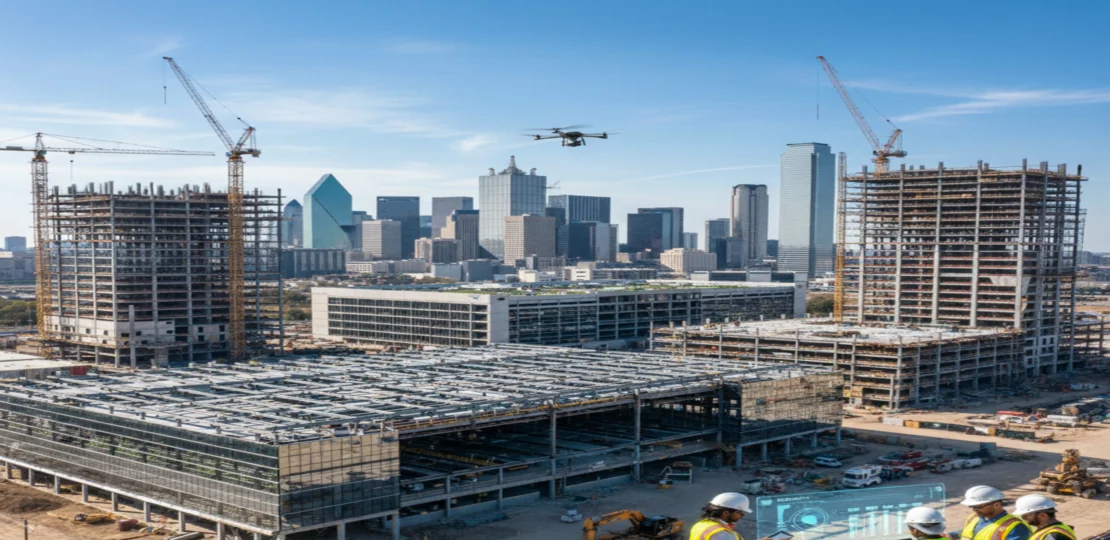
If you’ve been watching Dallas industrial construction over the last few years, you know it hasn’t just stayed busy, it’s evolved.
According to a report, Dallas–Fort Worth leads the nation in industrial construction, with over 24 million square feet of industrial space under construction across 96 properties, outpacing all other U.S. markets.
The DFW metro is now a magnet for logistics, light manufacturing, and advanced distribution, and 2025 is doubling down on that momentum. From warehouse development in DFW to next-gen logistics center construction, the region is setting the pace for commercial building trends nationwide.
Here’s what owners, developers, and tenants should expect, and how to plan your next move.
Supersized sheds aren’t going away, but the brief for new boxes is changing. On the spec side, the market is asking for clear heights in the 36’–40′ range, deeper truck courts, more dock doors per bay, and ESFR sprinklers as table stakes. What’s new is the built-in flexibility: shell buildings designed for mezzanine platforms, future office pods, and quick tenant improvements without structural surprises. In short, Dallas industrial construction is moving from “one-size-fits-all” to “configure-on-day-one.”
With population growth pushing outward and same-day delivery becoming the expectation, warehouse development in DFW is targeting infill parcels along key corridors (I-35, I-20, I-30, and I-45). Expect tighter footprints, higher parking ratios for vans and EV trucks, and smart circulation to reduce yard congestion. The winners are sites with quick access to arterials and the ability to turn product fast, logistics center construction optimized for speed, not just storage.
E-grocery, pharma, and food service are fueling one of the hottest sub-sectors of Dallas industrial construction: cold-chain. New builds and retrofits alike are adding convertible rooms (cooler/freezer/ambient), insulated metal panels, vapor barriers, under-slab heating, and redundancy in power.
What used to be a TI item is now part of the base design. Facilities are being built automation-ready with heavier power, expanded conduit, fiber pathways, and roof loads designed for AMRs/ASRS mezzanines. Mezz slabs are thicker, columns are spaced for robotic aisles, and floors get tighter FF/FL specs. For Dallas industrial construction, the conversation starts with “What’s your throughput?” and works backward to racking, robotics, and charging infrastructure.
Tilt-up construction remains king for schedule and cost control, but facades are getting nicer, with expansive glass at corners, articulated panels, and storefront entries that don’t feel like an afterthought. Inside, designers are maximizing daylighting, adding clerestories and skylights with high-R roofs and insulated panels to reduce HVAC loads. These are small touches that pay dividends in tenant comfort and operating costs.
Owners in Dallas aren’t chasing certifications for the plaque alone, they’re doing what pencils out. Think solar-ready roofs, EV charging for fleets and staff, high-efficiency HVAC for office pods, low-flow water fixtures, white TPO roofing, and LED with controls. Many commercial building trends now include embodied-carbon discussions (mix designs, recycled content) and stormwater enhancements to mitigate site risk during extreme weather.
Schedule remains the battleground. To hit delivery windows, teams are embracing design-build, early preconstruction, and permit phasing so dirt work, utilities, and foundations can start while detailing continues. Vendors are being prequalified earlier, and long-lead items (switchgear, dock equipment, roofing) are locked in during schematic. In 2025, Dallas industrial construction success often comes down to who engages value engineering early without compromising performance.
Developers are threading the needle with shells that suit a wide range of tenants but can pivot quickly to build-to-suit needs. That means oversizing utilities, designing columns for future mezzanines, and leaving knock-outs for office expansion or additional dock positions. As a result, faster lease-up and simpler conversions occur when tenant demands shift.
With tight labor markets, tenants are prioritizing sites that help recruit and retain people. Expect more natural light in offices and break areas, better air quality, shaded outdoor spaces, secure employee parking, and thoughtful pedestrian routes separated from truck traffic. Safety is being “designed-in,” not bolted on: clear sight lines, PIV/ESFR clarity, and well-marked circulation.
Why does the region keep winning? DFW Airport proximity, multimodal connectivity, a diverse labor pool, and pro-business fundamentals. For owners evaluating warehouse development in DFW, that combo shortens supply chains, lowers transport costs, and expands tenant pools. In 2025, expect continued absorption across distribution, manufacturing, and e-commerce users, all pushing commercial building trends toward speed, flexibility, and operational excellence.
The year 2025 favors owners and tenants who think beyond the box. If you approach Dallas industrial construction as an operations platform, not just a building, you’ll capture the full value of this market: speed, flexibility, and future-proof performance.
At Nortex Construction, we believe building is more than pouring concrete and raising walls, it’s about creating spaces that help businesses grow, move faster, and operate smarter. Whether it’s a warehouse development DFW, logistics center construction, or a tailored industrial facility, our design-build approach keeps the process simple, stress-free, and focused on your vision. With Dallas–Fort Worth leading the nation in industrial growth, we’re here to make sure your project isn’t just built for today, but ready for tomorrow.
Flexible, automation-ready buildings: higher clear heights, more power, and layouts that adapt for robotics, mezzanines, and evolving tenant needs.
Demand remains resilient, especially for infill and last-mile sites near major corridors. Cold storage and light manufacturing continue to add stable absorption.
Plan for ESFR sprinklers, 36’–40′ clear heights, deep truck courts, expanded trailer parking, robust power, fiber pathways, and EV charging readiness.
Engage design-build, phase permits, prequalify vendors, and lock long-lead items during schematic. Early value engineering prevents late-stage compromises.
LED + controls, solar-ready roofs, better envelopes (insulation/daylighting), and site circulation that cuts dwell time. These lower OPEX and boost tenant appeal.
View all

November 15, 2025 | by Nortex Construction

August 13, 2025 | by Nortex Construction

October 27, 2025 | by Nortex Construction